Physics

 Meaning of Acceleration with examples 

Acceleration is a vector quantity that is defined as the rate at which an object changes its velocity. An object is accelerating if it is changing its velocity.

Acceleration, rate at which velocity changes with time, in terms of both speed and direction. A point or an object moving in a straight line is accelerated if it speeds up or slows down. 

Some good examples of acceleration related to daily life are:
  1. When the car is speeding up
  1. When the car slows down
  1. When you fall off a bridge
  1. The car turning at the corner is an example of acceleration because the direction is changing. The quicker the turns, the greater the acceleration.

For example, if a car turns a corner at constant speed, it is accelerating because its direction is changing. The quicker you turn, the greater the acceleration. So there is an acceleration when velocity changes either in magnitude (an increase or decrease in speed) or in direction, or both.

In physics or physical science, acceleration (symbol: a) is defined as the rate of change (or derivative with respect to time) of velocity. It is thus a vector quantity with dimension length/time². In SI units, acceleration is measured in meters/second² using an accelerometer.

Acceleration (a) is the change in velocity (Δv) over the change in time (Δt), represented by the equation a = Δv/Δt. This allows you to measure how fast velocity changes in meters per second squared (m/s^2). Acceleration is also a vector quantity, so it includes both magnitude and direction.
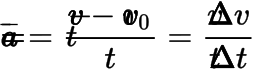
Formula
\overline{a} = \frac{v - v_0}{t} = \frac{\Delta v}{\Delta t}
\overline{a}=average acceleration
v=final velocity
v_0=starting velocity
t=elapsed time

constant acceleration 

Sometimes an accelerating object will change its velocity by the same amount each second. ... This is referred to as a constant acceleration since the velocity is changing by a constant amount each second. An object with a constant acceleration should not be confused with an object with a constant velocity.

Example of constant acceleration. 


Constant acceleration refers to motion where the speed increases by the same amount each second. The most notable and important example is free fall. When an object is thrown or dropped, it experiences a constant acceleration due to gravity, which has a constant value of approximately 10 meters per second square

Is constant acceleration 0? 

We define acceleration as change of velocity per unit time, and since velocity is constant the acceleration is 0. But in circular motion, the case is different. An object moving in uniform circular motion has constant speed (or magnitude of velocity) but still acceleration is not 0.

Positive acceleration 

Normally, we call acceleration a positive acceleration when the object moves in the positive direction(left to right) and the rate of change of velocity is positive(velocity is increasing). ... It is the same as an object decreasing the velocity in a positive direction.

Negative acceleration  

A body having a negative acceleration is said to be decelerating. Hence the negative acceleration of the body can be called the deceleration of the body. ... Since acceleration is a vector, the negative sign in equation (1) indicates that the acceleration of the body has a direction opposite to the velocity of the body


Comments

Popular posts from this blog

Recommended interval of receiving covishield

PHYSICS

வயிற்றுப்போக்கை நிறுத்த உதவும் உணவு வகைகள்